GENOME sequencing of the highly invasive Asian Tiger mosquito in the Torres Strait is one of two $25,000 research grants awarded by Far North Queensland Hospital Foundation.
The Foundation has provided a $25,000 grant to James Cook University PhD candidate Tom Swan to investigate the distribution, dispersal and ecology of the Asian Tiger mosquito. This will involve catching them in the Torres Strait using a range of novel trapping tools.
Another aspect will involve sequencing the genome of the Asian Tiger mosquito. “That will help us better understand the biology of this mosquito, including the potential pathways they might follow in spreading through the Torres Strait,” Mr Swan said.
The Asian Tiger mosquito can carry both the dengue and chikungunya viruses, and has been a global public health threat for many decades now. As a result of globalisation, humans have transported the Asian Tiger mosquito into new regions, helping it achieve almost worldwide distribution.
“As well as being a major threat to public health, this mosquito is famously called ‘the barbecue killer’ because it’s a vicious, daytime biter and can have a big impact on people’s lifestyle,” Mr Swan said.
Since Asian Tiger mosquitoes invaded the Torres Strait in 2005, they have been responsible for local transmission of dengue on Erub, Boigu and Badu Islands. Mr Swan said he and other experts consider it may only be a matter of time before this mosquito invades mainland Queensland.
“The Asian Tiger is considered one of the 100 worst invasive species,” Mr Swan said. “If it invaded Far North Queensland it could potentially compromise the success of the Eliminate Dengue program, by displacing Aedes aegypti mosquitoes that have been ‘vaccinated’ against dengue with Wolbachia.”
Presently, the Asian Tiger mosquito has been successfully suppressed on Thursday and Horn Islands as a result of a successful Asian Tiger mosquito Eradication Program, but little control has been conducted on the outer islands. “Findings from this research will be used to better understand the biology of the Asian Tiger Mosquito and to evaluate novel mosquito trapping tools for use on the outer islands,” Mr Swan said.
The second large research project will be conducted by Weipa-based occupational therapist Alice Cairns PhD.
Dr Cairns, a HOT North Research Fellow at JCU’s Centre for Rural and Remote Health, is supporting the Student-led Community Rehabilitation and Lifestyle. This collaboration between James Cook University and local health services involves allied health students working in multi-disciplinary teams.
“Because we don’t have a great deal of resources here, but we do have regular students here on clinical placements, we thought we could better utilise them to help improve outcomes,” Dr Cairns said.
“Often in remote communities like Napranum, if a person has a stroke or a disability and goes home, they don’t have access to community rehabilitation services like they would in larger towns and cities.
“In this project, each patient will be supported by a team of allied health students. For example, someone who has had a stroke might see a team that includes physiotherapy, occupational therapy, speech therapy and social work. The students will work together, fully supervised, to fill a service gap and potentially improve the patient’s outcome and prevent hospital readmissions,” she said.
The research project will entail students being appropriately supported and supervised, a project officer to develop procedures and collate results and some further analysis by Dr Cairns to assess outcomes.
Originally from Mareeba, Dr Cairns is passionate about allied health services in remote communities.
“The chronic disease load in these remote communities is incredibly high and allied health professionals can have a very positive impact,” she said.
The Foundation has provided a $24, 800 grant to Dr Cairns through the JCU’s Centre for Rural & Remote Health.
Foundation chairman Dr Ken Chapman said the Foundation this year funded $112, 000 in research grants.
“The Foundation sees investing in research as paramount to the future of healthcare in our community,” Dr Chapman said.
In the 2018-2019 financial year, the Foundation is providing $162, 000 towards local research – its biggest ever commitment.
That is comprised of $50, 000/year for three years towards a research support officer (in conjunction with JCU); two large grants of $25, 000 each, and a further $62, 000 towards smaller grants.
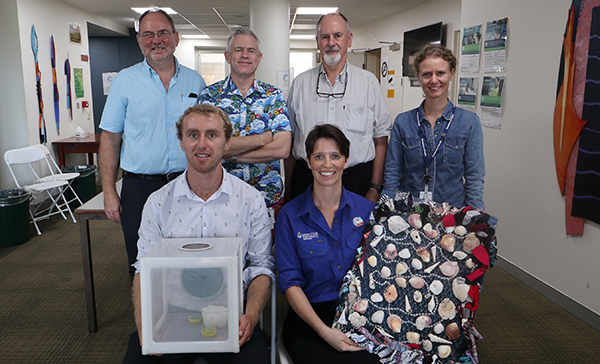
Photo: Foundation chairman Dr Ken Chapman, Dr Edward Strivens, Prof John McBride, Cairns Clinical School research support officer Dr Luisa Roeder, researchers Tom Swan and Alice Cairns.